Showing posts with label Birdwatching. Show all posts

Wednesday, February 24, 2016

Sad Birds of Japan


            Meet Jim. Jim’s a nice guy. Jim isn’t picky about what he eats; he’s an omnivore. Jim is pretty sociable and well behaved, so nobles of Japan’s Heian period (794-1185) liked to keep his kind as pets. Heian means “peace”, and the period is celebrated for its poetry and literature. Brown-eared Bulbuls were a part of that. Jim is also a pollinator, which is unusual for birds his size, and he can eat the fruits of 53 different plants, helping disperse their seeds. As such Jim is a good friend of the forest, too. Now this would make Jim an esteemed and accomplished member of society, but underneath this respectable façade lies a secret. You see Jim has a problem. He’s seen things. Terrible things.

          Meet Jim, the bird who suffers from PTSD. While everyone else is enjoying the multitudes of treasures and pleasures that Japan has to offer, Jim can be heard reliving the horrors of his troubled past. His long, high-pitched screams will wake you up in the morning, or they will jar you out of your daydreams. This has led many to call Jim a “Noisy Bulbul”, which is rather insensitive considering his condition. Poor Jim, listen to him. Only the trees of the forest know what Jim has seen, what Jim has done. Since I don’t speak Entish, I guess we’ll never know his secret.

You might meet Jim in Japan, Korea, Eastern China or Taiwan. So please, if you see Jim, try to talk him into getting the professional help he needs. We’ve all suffered enough.


            Now meet a lovely owl whose exact name I’ve forgotten. He or she, let’s say “she” this time and call her Kim, is a Spectacled Owl, found mostly in South America. The poor thing was a newcomer to the owl café (yes, owl cafés are a thing in Japan), having arrived only three weeks before our visit. Far from being welcomed by its brethren, they had bullied Kim mercilessly day and night. The staff said this was because owls are territorial, but also because they found her dark face scary and intimidating. The owls all glared at Kim, especially the “queen” of the café, who never broke eye contact with her. It became a game to see how far she would go to keep glaring at Kim. She cared about nothing except giving Kim the evil eye. That was her whole day. Poor Kim sat on her perch, barely daring to move. We felt sorry for Kim. We shouldn’t have.
            It turns out that Spectacled Owls aren’t well liked in the wild either. They are solitary animals, getting together only with their own species and then only to mate. While owls usually answer or react to the calls of other owls even from different species, the Spectacled Owl probably wouldn’t piss on them if they were on fire. The Spectacled Owl often can’t even be bothered to answer calls from its own species. The only interaction it wants is sexual. If you’re not making a booty call, the Spectacled Owl does not give a shit about you. This anti-social behavior starts early. Spectacled Owls usually lay one or two eggs, but the weakest one rarely survives since its stronger sibling forces it to starve or kills it outright.


         Well I can’t dislike an owl; I still love you Kim. And I think it’s mutual, just look at the affection in her eyes.

Oops, not that one, maybe it’s more visible in the next one.
Damn. Just, trust me.

Sunday, February 21, 2016

Everest Base Camp Trek - Journal (Part 4)


For our EBC Trek cost-cutting tips.
For a guide to take you there, contact Ngima Tamang.
For part 1 of this EBC Trek journal. It covers days 1 to 3, from Lukla to Phakding to Namche Bazaar.
For part 2 of this EBC Trek journal. It covers days 4 to 6, from Namche Bazaar to Tengboche to Dingboche.
For part 3 of this EBC Trek Journal. It covers days 7 to 9, from Dingboche to Everest and back to Gorak Shep.


Gorak Shep, the town at the end of the world, seen from Kala Pattar. In the middle of the night, it looks smaller, almost fearful of the mountains surrounding it.


Day 10 - The Town at the End of the World
Waking up at 3 :30AM, we threw on every piece of clothing we had in order to take on Kala Pattar before the sun brought the world out of deepfreeze. Leaving Gorak Shep, we were not in total darkness. A crescent moon smiled at us, and the canopy of stars, though not as impressive as in Dingboche on day 7, reserved a special gift for us. Squid saw a long shooting star. 
The sun is just about to take a peek in the valley.
We slowly, tortuously made our way up the snow and rocks, and from a height, all alone in this inhospitable landscape, Gorak Shep looked puny and lost. We were looking at the furthest reach of human civilisation, an isolated outpost forgotten on a distant planet. We certainly dressed the part, bundled up and protected like astronauts. But the cosmos shrank a little when, gingerly at first but with increasing regularity, other hikers came to join us, making us feel connected once again. Then the autumn sun dawned, and all but the Morning Star took a bow in the now purple sky. When it turned pink, even Venus conceded defeat, as we almost did. The trail took us 400 metres up through treacherous rocks and ice in arctic weather. Squid’s feet were wet somehow, and she imagined her toes blackened by frostbite. They felt as though they would have to be amputed. She was not having fun. We left Kala Pattar almost as soon as we reached it, unable to bask in our accomplishment, and our longest day had only begun. Even after a 3-hour hike, a 9-hour slog awaited us, going back through Gorak Shep for breakfast, then on through Lobuche to Thukla for lunch, and finally to Pheriche, with a brief camera pause at the Everest victims’ memorials. That’s what I’d forgotten on day 8.

The view from the memorials.
The location for the memorials was well-chosen, providing probably the most striking views of the entire trek. There you can find the memorial for Scott Fischer, immortalized in Everest (based on Into Thin Air), as well as the memorial for Babu Shiri Sherpa, who summitted Everest ten times before the age of 36. He once climbed it twice in two weeks, and he set the records for the fastest summitting and the longest time on Everest without auxiliary oxygen. He also holds the record for being the youngest to summit. But I don’t know if anyone can ever conquer Everest. Babu Shiri Sherpa died during his 11th attempt to summit, falling into a crevasse. A chilling reminder that Everest defeats even our most gifted and deft. That Tenzig Norgay and Edmund Hillary won the battle of Man vs. Everest for the first time over 60 years ago is a herculean accomplishment. First atop Everest, they have become giants in my eyes.

Other pictures from day 10:


The last of dawn's pink light is almost gone, and there's finally enough
light for my camera to take usable pictures.
Wherever the sunlight isn't hitting yet, it is minus Jesus! Fuck! degrees.
Even our guide was cold because we were so slow.
Near Pheriche, racing against the sun and clouds to arrive before nightfall and its chill.


Day 11 - Making Up for Lost Time
A day lost to snow and rain in Namche on day 4 meant another long day today to catch up,from 8AM to 5PM with about an hour’s break for lunch in Phungke Tenga. I was too tired to write. Still, today was one of the best days of the trek. The road from Pheriche to Tengboche, and Tengboche to Namche carries you through a variety of landscapes, and a relative multitude of towns. 
Mornings make you feel reptilian. The first order of business is always to get your ass into the sun as quickly as possible.


We got to see Ama Dablam in all its glory, dominating the Khumbu Kola valley, magnificient in the midday sun. We got reacquainted with fire bushes and ghost trees, but just when we thought the trip was winding down, and the trail had nothing new to offer, it proffered up birds of all kinds, including a vulture and the strangely out of place looking national bird of Nepal. The Himalayan Monal is much more colorful than I expected Himalayan birds to be.
As the clouds rolled in close to Namche, the world disappeared, enveloped by clouds to leave only the trail about as far as a lantern's glow. There was nothing but the trail and us. It was a fitting image for what the past 10 days had been, when our life shrank to one objective and the road that was taking us to it. I relished the simplicity and peacefulness of it, the camaraderie born of sharing the same goal, and the small town feel of bumping into the same people over and over again. For 11 days the world had made sense, and I knew my place in it from morning to night. All the little nags of the daily grind, all the suffering in the world had receded from my mind and it would have been happy never to bear their assault again.
At that moment I was melancholy, reluctant to leave behind this simple, fulfilling life. Then a light breeze blew. The fact I could smell my own stink brought me back to reality and the need I had for the creature comforts of the civilized world : a hot shower, warm nights, internet access, varied cuisine, beer, skyping with family, a change of clothes, clean clothes, a heat source other than yak dung…  They say meditation brings enlightenment, but breathing your own stink works just as well. Just one more day until Kathmandu.


Other pictures of Day 11:

Once you hit sunlight, you hit your stride. All you need to do is to
avoid the yaks.
I don't know what they're called but you can see why I choose to
call them fire bushes.

Ngima Tamang and Squid, near one of the many "tea houses" or
lodges.
Nepal's national bird. What exactly is such a large colorful bird
doing 3000m. up?


Day 12 - Day of the Donkey, Squid Takes Off
The trail was very crowded as it was market day in Namche. Porters zipped up and down the trail as though they weren’t carrying the equivalent weight of a small whale, while donkey caravans and ox trains created traffic jams. Of all the pack animals, donkeys are the smelliest, and on parts of the trail, it was impossible to avoid the dung. We did our best to keep moving and we scored a small moral victory : we could hear Ngima breathing.
Not hard, and it was probably because he was sick, but nevermind all that. It felt as though we were finally fast enough to give him some exercise. The man once made the entire trip down from EBC to Lukla in twelve hours, because one of his charges had been airlifted out, but we chose to ignore the more obvious culprits and decided it was because we were setting a good pace. Stop scoffing ! We finally arrived in Lukla at 3 :30PM. Our journey was at an end at last. A hot shower was just a night’s sleep away. Or so we hoped. I was worried our flight the next day would be cancelled, as they often are, forcing us to extend our stay. We would then have to withdraw more money at a very bad rate, and I’d had enough of that. But there was nothing to do but hope for good weather and watch the children of Lukla at play from the hotel windows. The hotel was freezing cold, the bathroom smelled like someone had died in it, but the food and the company were good. That was all we needed anyway.


Day 13 - Departure ?

I woke up at 5AM, worried about the flight. I heard what sounded like rain, so I had little hope. In the end though, our luck came through again. By 8, the skies were clear and the sun was out. We boarded the plane, as the exhaust from the plane made the plants behind it shiver. The flight was beautiful. This time, there were no clouds to hide the valleys and villages. I marveled at all these isolated hamlets, tenuously sewn together by thin trails, spreading over plateaus or nestled atop ridges. I remembered signs on the trail talking about the musk deer of Phorche, the various monastic retreats, the festival in Tengboche or the painting school in Lukla. Each of the villages we were flying over seemed to hold such a secret, waiting to be shared with travellers if only they could find their way there. Nepal looks full of surprises waiting to be reavealed. I can't wait to return.

Our thanks go out to Ngima Tamang and the HappyHimalaya.com team for making it possible.

Thursday, February 4, 2016

Everest Base Camp Trek - Journal (Part 3)

For our EBC Trek cost-cutting tips, go here.
For part 1 of this EBC Trek journal, go here. It covers days 1 to 3, from Lukla to Phakding to Namche Bazaar.
For part 2 of this EBC Trek journal, go here. It covers days 4 to 6, from Namche Bazaar to Tengboche to Dingboche.
For part 4 of this journal, go here. It covers day 10 to 13, from Gorak Shep to Everest and back down to Lukla.


Dingboche

Those little colored spots are the roofs of Dingboche, which we set out from and returned to on Day 7. The man in the middle is our guide, Ngima.


Day 7 - Yak City
Our second rest day was spent climbing to 5000m before lunch. Once more, clear blue skies stretched from peak to peak above us. The climb, though strenuous, did much to calm my fears of altitude sickness. Reaching 5000m felt like an achievement, and it made the highest point on our trek, Kala Pattar’s 5550m, appear less daunting. Although I’d had mild headaches on day 6 and during this climb, they were gone before we returned for lunch. I was happy to bump into Iva, Mark and Catalina again, near the top of our ascent. We got some pictures in with Catalina, Iva and Ngima to celebrate our achievement.

Ngima, Iva and Squid.
  Moments later, an eagle graced us with its presence, consecrating the day by soaring not 20 feet in front of us. I believe Homer’s Greeks would have considered it a good omen, and watching it sweep majestically overhead, there was surely no better place to be at that moment. It was so close ! Seeing it first, stunned, I could only blurt out weird sounds to make the others look up. They must have thought for a second that I had had an aneurysm. Luckily for me, the eagle's majesty made everyone forget how moronic I’d just sounded. In a moment he was out of sight, our cameras barely turned on, but at least the memory is etched in my brain. 

Back at the hotel, we had a hearty meal in the blazing sun, and a nice chat with an older American couple from San Jose. People say the trail is a great equalizer. The man was in his 70s ! Then, I had to go explore Dingboche in order to set up an evening of revelry that Catalina had proposed earlier. Of course, Catalina and Mark were staying further up, and Iva was staying further down from us. With no path connecting our Hotel Good Luck to the main road, I went all the way around to catch the road, crossed the town to Iva’s hotel, then went around again back to Good Luck. Dingboche, I dub thee : Yak City. There were yaks at every corner, watching me from hilltops, from yards, from almost within a small shop… There were more yaks than people.
               At around 7 we suited up (remember, it’s bloody cold at night) and went out for a wild night on the town. We arrived at Mark and Catalina’s hotel, the Grand Himalayan Resort, to… play Monopoly. Party animals we. At eight, we put away the game to go to bed; it was late. And that was by far our "wildest" night in the Himalayas. I’ve been pitching the idea to the writers of The Hangover but so far no luck. I just need to keep at it.
Walking back to our hotel under a new moon, we could clearly see the stars and the Milky Way. Framed by the mountains, it was stunning. We could have stayed there all night but for the fear of death by turning into a popsicle. Getting home was an adventure in itself, walking in pitch darkness with one headlight over stone walls, under wire fences around freezing puddles, yak droppings and a man farting alone in the night. The poor man was minding his own business, farting loudly in the dark next to a large boulder. When we heard a loud ripping noise, we did what anyone would do when startled, we turned in the direction of the noise. But Squid had a headlamp on, so the man went from farting alone in the dark to being caught in a spotlight with an audience. We held our chuckles a few steps to preserve the last shreds of his dignity then snickered as quietly as we could. He should have blamed it on the yaks.


Day 8 - This entry was eaten by a mountain goat.
        Day 8 is lost to my memory. I never realized I was that tired. Hopefully the pictures will help to fill the blanks in my mind. I do remember playing Monopoly with Catalina and Mark and worrying about Iva. That day he didn’t bump into us and we couldn’t find him in the tea houses in Lobuche either. After the conversation we’d had the day before about him not taking altitude sickness medicine, I hoped he’d simply taken an extra day to acclimatize. Our tea house, though expensive, was pretty bare. It was 22 days old and the final touches hadn’t been put. It was also close to empty. A Japanese fellow and we were its only customers. That just meant we had the pleasure of getting real close and personal with the yak dung burning in the stove. This was the most dangerous time in our journey. For this night and the next, we would be sleeping at close to 5,000m, but Everest was just on the other side of the night, a few hours' walk away on the Khumbu glacier.

Here's what I'd forgotten from Day 8, except for the memorials which I will talk about in part 4 of this journey.

Setting off from Dingboche.


Day 9 - Success
            We made it to base camp.
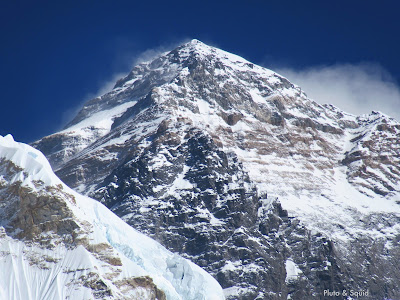
Mount Everest
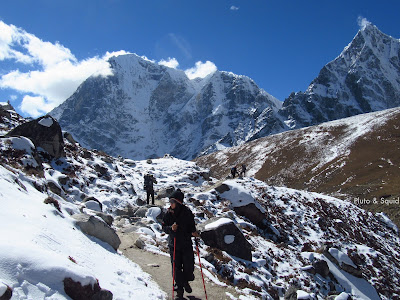
We fought and vanquished the fatigue, the cold and the headaches. Those gave me a scare, but they came and went. That morning, buddhist music was playing in the tea house. I'm not religious, but those mantras came in handy. I believe fear can make you sick the same way the placebo effect can cure you. At over 5000m of altitude, worrying about altitude sickness wasn't something I wanted to obsess over until my imagination ran away from me and became real. To clear my thoughts and keep calm, I kept chanting those mantras to myself. Whether they actually kept me healthy or whether they simply kept me calm, I was thankful to have them in mind. There were times, atop the ridge channeling the Khumbu glacier, when the excitement overpowered everything else. After nine days, we were going to see Everest. It wouldn’t feel like cheating this time. Finally, just before base camp, we got our first glimpse. Everest was hidden by two other mountains so that we could only see the summit, but it was a perfectly clear day. We might have been able to see a climber if there had been any. It felt so close, it was easy to picture myself at the top. The Nepali side does not offer the best views of Everest, those are to be had from Tibet. But we much preferred hiking to Everest than driving, and the view of the summit from so close filled us with awe. There it was, an 8,848m tall mass murderer with over 250 victims. There are over 200 bodies on that mountain, "because it's there", as Edmund Hillary put it, or because it represents the final challenge for those who wish to conquer Nature. We could see snow being blown off its peak.
        Unexpectedly, we got to see many beautiful birds along the way, and Ngima got up real close to some of them. The birds reacted no differently than if he’d been a mountain goat. Which of course he is as his uncanny climbing ability and predilection for sticking blades of grass in his mouth demonstrates (or he is rather a were-goat), so it makes sense. One red bird, the Spotted Great Rosefinch, came to look in on us at base camp, which made my day all the better. The walk back was the most exhausted we’d been on the trek up to that point, and I looked at the next day with not just a little apprehension. We were among the very last to reach EBC that day, due to our inefficiency over rocky terrain. If Ngima is a were-goat, than we must be were-turtles, and we would have to get up even higher on day 10 to reach Kala Patthar. 
                  The altitude was taking its toll on my mind. My reasoning was slow, unidirectional and full of errors, so this entry in my journal was skin and bones. Still, I had enough presence of mind at base camp to take out a Snickers, dip it in peanut butter and live the life. Does it get any better than that ?


Khumbu glacier
Gorak Shep


Super photogenic horse
Khumbu glacier


Spotted Great Rosefinch, at Everest Base Camp.
Credit: Ngima Tamang