For our EBC Trek cost-cutting tips, go here.
For part 1 of this EBC Trek journal, go here. It covers days 1 to 3, from Lukla to Phakding to Namche Bazaar.
For part 2 of this EBC Trek journal, go here. It covers days 4 to 6, from Namche Bazaar to Tengboche to Dingboche.
For part 4 of this journal, go here. It covers day 10 to 13, from Gorak Shep to Everest and back down to Lukla.
 |
| Dingboche |
 |
| Those little colored spots are the roofs of Dingboche, which we set out from and returned to on Day 7. The man in the middle is our guide, Ngima. |
Day 7 - Yak City
Our second rest day was spent climbing to 5000m before lunch. Once more, clear blue skies stretched from peak to peak above us. The climb, though strenuous, did much to calm my fears of altitude sickness. Reaching 5000m felt like an achievement, and it made the highest point on our trek, Kala Pattar’s 5550m, appear less daunting. Although I’d had mild headaches on day 6 and during this climb, they were gone before we returned for lunch. I was happy to bump into Iva, Mark and Catalina again, near the top of our ascent. We got some pictures in with Catalina, Iva and Ngima to celebrate our achievement.
 |
| Ngima, Iva and Squid. |
Moments later, an eagle graced us with its presence, consecrating the day by soaring not 20 feet in front of us. I believe Homer’s Greeks would have considered it a good omen, and watching it sweep majestically overhead, there was surely no better place to be at that moment. It was so close ! Seeing it first, stunned, I could only blurt out weird sounds to make the others look up. They must have thought for a second that I had had an aneurysm. Luckily for me, the eagle's majesty made everyone forget how moronic I’d just sounded. In a moment he was out of sight, our cameras barely turned on, but at least the memory is etched in my brain.
Back at the hotel, we had a hearty meal in the blazing sun, and a nice chat with an older American couple from San Jose. People say the trail is a great equalizer. The man was in his 70s ! Then, I had to go explore Dingboche in order to set up an evening of revelry that Catalina had proposed earlier. Of course, Catalina and Mark were staying further up, and Iva was staying further down from us. With no path connecting our Hotel Good Luck to the main road, I went all the way around to catch the road, crossed the town to Iva’s hotel, then went around again back to Good Luck. Dingboche, I dub thee : Yak City. There were yaks at every corner, watching me from hilltops, from yards, from almost within a small shop… There were more yaks than people.
At around 7 we suited up (remember, it’s bloody cold at night) and went out for a wild night on the town. We arrived at Mark and Catalina’s hotel, the Grand Himalayan Resort, to… play Monopoly. Party animals we. At eight, we put away the game to go to bed; it was late. And that was by far our "wildest" night in the Himalayas. I’ve been pitching the idea to the writers of The Hangover but so far no luck. I just need to keep at it.
Walking back to our hotel under a new moon, we could clearly see the stars and the Milky Way. Framed by the mountains, it was stunning. We could have stayed there all night but for the fear of death by turning into a popsicle. Getting home was an adventure in itself, walking in pitch darkness with one headlight over stone walls, under wire fences around freezing puddles, yak droppings and a man farting alone in the night. The poor man was minding his own business, farting loudly in the dark next to a large boulder. When we heard a loud ripping noise, we did what anyone would do when startled, we turned in the direction of the noise. But Squid had a headlamp on, so the man went from farting alone in the dark to being caught in a spotlight with an audience. We held our chuckles a few steps to preserve the last shreds of his dignity then snickered as quietly as we could. He should have blamed it on the yaks.
Day 8 - This entry was eaten by a mountain goat.
Day 8 is lost to my memory. I never realized I was that tired. Hopefully the pictures will help to fill the blanks in my mind. I do remember playing Monopoly with Catalina and Mark and worrying about Iva. That day he didn’t bump into us and we couldn’t find him in the tea houses in Lobuche either. After the conversation we’d had the day before about him not taking altitude sickness medicine, I hoped he’d simply taken an extra day to acclimatize. Our tea house, though expensive, was pretty bare. It was 22 days old and the final touches hadn’t been put. It was also close to empty. A Japanese fellow and we were its only customers. That just meant we had the pleasure of getting real close and personal with the yak dung burning in the stove. This was the most dangerous time in our journey. For this night and the next, we would be sleeping at close to 5,000m, but Everest was just on the other side of the night, a few hours' walk away on the Khumbu glacier.
Here's what I'd forgotten from Day 8, except for the memorials which I will talk about in part 4 of this journey.
 |
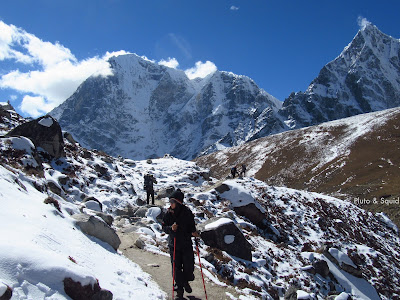
| Setting off from Dingboche. |




Day 9 - Success
We made it to base camp.
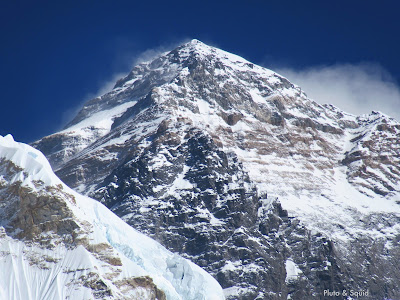 |
| Mount Everest |
We fought and vanquished the fatigue, the cold and the headaches. Those gave me a scare, but they came and went. That morning, buddhist music was playing in the tea house. I'm not religious, but those mantras came in handy. I believe fear can make you sick the same way the placebo effect can cure you. At over 5000m of altitude, worrying about altitude sickness wasn't something I wanted to obsess over until my imagination ran away from me and became real. To clear my thoughts and keep calm, I kept chanting those mantras to myself. Whether they actually kept me healthy or whether they simply kept me calm, I was thankful to have them in mind. There were times, atop the ridge channeling the Khumbu glacier, when the excitement overpowered everything else. After nine days, we were going to see Everest. It wouldn’t feel like cheating this time. Finally, just before base camp, we got our first glimpse. Everest was hidden by two other mountains so that we could only see the summit, but it was a perfectly clear day. We might have been able to see a climber if there had been any. It felt so close, it was easy to picture myself at the top. The Nepali side does not offer the best views of Everest, those are to be had from Tibet. But we much preferred hiking to Everest than driving, and the view of the summit from so close filled us with awe. There it was, an 8,848m tall mass murderer with over 250 victims. There are over 200 bodies on that mountain, "because it's there", as Edmund Hillary put it, or because it represents the final challenge for those who wish to conquer Nature. We could see snow being blown off its peak.
Unexpectedly, we got to see many beautiful birds along the way, and Ngima got up real close to some of them. The birds reacted no differently than if he’d been a mountain goat. Which of course he is as his uncanny climbing ability and predilection for sticking blades of grass in his mouth demonstrates (or he is rather a were-goat), so it makes sense. One red bird, the Spotted Great Rosefinch, came to look in on us at base camp, which made my day all the better. The walk back was the most exhausted we’d been on the trek up to that point, and I looked at the next day with not just a little apprehension. We were among the very last to reach EBC that day, due to our inefficiency over rocky terrain. If Ngima is a were-goat, than we must be were-turtles, and we would have to get up even higher on day 10 to reach Kala Patthar.
The altitude was taking its toll on my mind. My reasoning was slow, unidirectional and full of errors, so this entry in my journal was skin and bones. Still, I had enough presence of mind at base camp to take out a Snickers, dip it in peanut butter and live the life. Does it get any better than that ?
 |
| Khumbu glacier |
 |
| Gorak Shep |
 |
| Super photogenic horse |
 |
| Khumbu glacier |
 |
| Spotted Great Rosefinch, at Everest Base Camp. |
 |
| Credit: Ngima Tamang |
 Day 8 is lost to my memory. I never realized I was that tired. Hopefully the pictures will help to fill the blanks in my mind. I do remember playing Monopoly with Catalina and Mark and worrying about Iva. That day he didn’t bump into us and we couldn’t find him in the tea houses in Lobuche either. After the conversation we’d had the day before about him not taking altitude sickness medicine, I hoped he’d simply taken an extra day to acclimatize. Our tea house, though expensive, was pretty bare. It was 22 days old and the final touches hadn’t been put. It was also close to empty. A Japanese fellow and we were its only customers. That just meant we had the pleasure of getting real close and personal with the yak dung burning in the stove. This was the most dangerous time in our journey. For this night and the next, we would be sleeping at close to 5,000m, but Everest was just on the other side of the night, a few hours' walk away on the Khumbu glacier.


